When the Record Collection Becomes a Life Raft: Music for the Moments That Rearrange You

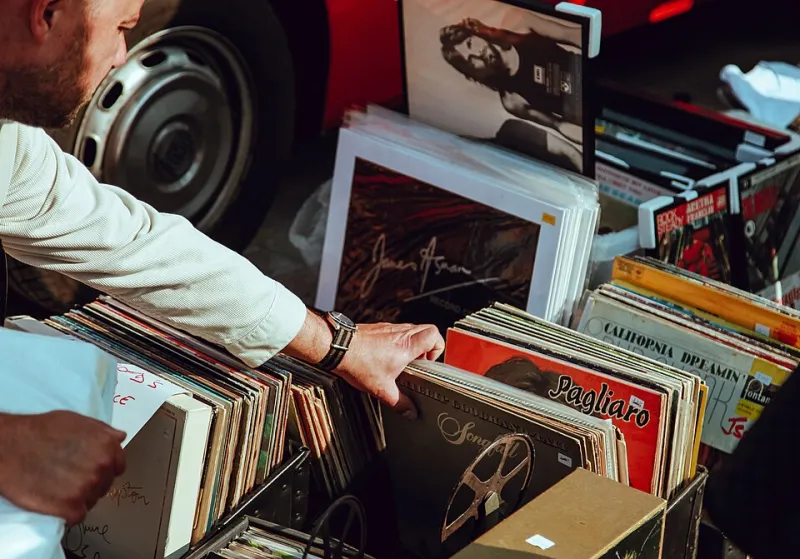
Photo: jaocampoz, CC0, via Wikimedia Commons
There's a specific kind of Tuesday night that every guy over thirty-five knows intimately. The kids are in bed, or maybe they're not even in the house anymore. The couch feels enormous. You've got a drink you're not really tasting, and somehow — without consciously deciding to — you've put on an album you haven't touched in a decade. And it absolutely destroys you. In the best way. In the only way that actually helps.
This is the part of being a music fan that nobody talks about enough. Not the discovery, not the nostalgia tour tickets, not the arguments about vinyl versus streaming. The part where a record becomes a coping mechanism. Where an artist becomes the only voice in the room that seems to understand the specific flavor of chaos your life has become.
Call it Divorce Rock if you want — but honestly, it applies to a lot more than divorce. Job loss. Kids leaving for college. A friendship that quietly dissolves over three years without a single dramatic fight. The death of a parent. The realization that the version of yourself you planned on becoming... didn't quite show up. These are the moments when the music you've been casually collecting your whole life suddenly earns its keep.
Why Certain Genres Show Up When You Need Them
It's not random. When life hands you something genuinely heavy, your brain isn't looking for a banger. It's looking for a witness. Something that says I've been here too, and I survived it, and here's what it sounded like from the inside.
That's why alt-country and Americana become a spiritual experience for so many dads going through it. There's something about the genre's DNA — the acceptance of loss, the dusty fatalism, the way a pedal steel guitar sounds like a sigh you've been holding for six months — that meets you exactly where you are. Townes Van Zandt isn't going to fix your problems. But he's going to sit with you in them, and that's sometimes the more useful thing.
Similarly, the quieter corners of indie rock have a way of surfacing during transitions. The National have built an entire career soundtracking the specific melancholy of middle-aged men who feel things deeply and express it approximately never. Boxer, High Violet, Sleep Well Beast — these aren't sad records exactly. They're precise records. And precision is comforting when everything else feels like static.
The Albums That Actually Do the Work
Let's get specific, because vague recommendations are useless when you're actually in the thick of it.
Bruce Springsteen — Tunnel of Love Everyone reaches for Born to Run when they want Bruce, but Tunnel of Love is the one that matters when a relationship is fracturing or already fractured. It's quiet, unsettled, and brutally honest about the way love can become a house you don't recognize anymore. Springsteen made this right before his own marriage ended, and you can feel every bit of that tension in the grooves.
Wilco — A Ghost Is Born Jeff Tweedy wrote this record while battling addiction and watching his marriage strain under the weight of it. It's abrasive in places, tender in others, and it captures something true about the way men process pain — by burying it under noise until it finally breaks through. Put on "Hummingbird" and try not to feel something. I'll wait.
The Hold Steady — Stay Positive Here's the thing about processing hard stuff: you can't stay in the pit indefinitely. At some point, you need something that acknowledges the wreckage but still believes in getting through it. Craig Finn writes about flawed people who keep trying anyway, and for a lot of dads in the middle of a transition, that's exactly the theology they need.
Jason Isbell — Southeastern If you haven't heard this record, stop reading and go fix that. Isbell wrote it fresh out of rehab, newly sober, rebuilding a life from the foundation up. It's the best album about second chances made in the last twenty years, and it will reach into your chest and rearrange something. "Cover Me Up" alone is worth whatever you're going through.
Elliott Smith — Either/Or Yes, it's devastating. No, it won't make you feel worse — it'll make you feel understood, which is different. Smith's ability to articulate the specific loneliness of being a person who feels too much in a world that rewards feeling too little is unmatched. Handle with care, but don't avoid it.
The Ritual Matters as Much as the Music
Here's something the algorithm can't replicate: the physical act of sitting with an album during a hard time creates a kind of memory encoding that changes how you hear that record forever. That's not always comfortable — there are albums some of us can't revisit because they're too tightly bound to a specific pain. But it also means music can become a genuine landmark in your personal history.
The dad who listened to Southeastern on repeat the summer his marriage ended didn't just get through that summer. He built a relationship with that record that will last the rest of his life. It becomes his. That's the deal music offers that nothing else quite does.
So if you're in one of those seasons right now — the empty house, the fresh start that doesn't feel fresh yet, the loss you're still figuring out how to carry — don't reach for the comfort playlist. Don't put on the stuff that's easy. Find the record that meets you where you actually are, not where you wish you were.
A Note on Not Drowning in It
There's a difference between using music to process something and using it to marinate in misery indefinitely. The records above are tools, not destinations. You're supposed to feel them, let them do their work, and eventually — gradually — find yourself reaching for something with a little more light in it.
That's actually how you know it's working. When the Isbell starts feeling less like a wound and more like a scar. When you can put on Tunnel of Love and appreciate the craft instead of just surviving the emotion.
The collection you've been building your whole life? It was always going to be there for this. That's what it was for.